Oh! Music Theory
  • Home
  • 专栏文章Articles
    • 五分钟乐理
    • 乐理101
    • 吉他恋爱手札
    • 吉他上の咏叹调
  • 付费内容Member Only
  • 作品My Music
  • 联系方式 Contact
  • Home
  • 专栏文章Articles
    • 五分钟乐理
    • 乐理101
    • 吉他恋爱手札
    • 吉他上の咏叹调
  • 付费内容Member Only
  • 作品My Music
  • 联系方式 Contact

【Jazz】Mapping Upper Structure into Diatonic Context

2/25/2018

0 Comments

 
Picture
以下是我对Upper Structure的研究笔记,供骨灰玩家玩味。本文谢绝转载,谢谢。

​1. Altered Chord

Whenever jazz players get bored with the bland dominant 7th chords, they opt for something spicier — the ALTERED chords. 

The altered chord is a chord derived from the seventh mode of melodic minor scale, which is called the "super locrian mode", or simply the "altered scale". This scale is composed of scale degree 1 b2 b3 b4 b5 b6 b7, or enharmonically 1 b9 #9 3 b5 #5 b7. In practice, b5 and #4 are used interchangably, same with #5 and b13. 

The altered scale includes all the altered notes one can substitute for a dominant chord. Theses altered notes bring colorful tensions to the originally dominant chord, and make the resolution even stronger when the chord returns to the tonic. 

To construct an altered chord, we can add any of the altered note b9 #9 b5 #5 to the shell dominant chord 1 3 b7. For example, G7b9b5 consists of 1 3 b7 b9 b5. 

However, the 13th note is not always flatted in the altered chords. Chords like G13b9 appear quite often in Jazz. The natural 13th note can be used instead of the b13. The #5/b13 and 13 rarely exist together, as they'll create a dissonant minor 9th interval. 

To play over an altered chords with a natural 13th inside, Jazz players usually choose the "dominant diminished scale", aka. the "half-whole diminished scale". The scale is an octatonic scale composed of scale degree 1 b9 #9 3 b5 5 13 b7, with alternating half and whole steps between the notes. Although usually omitted, the natural 5th a valid note in this case.

There is another scale called "Lydian Dominant" scale 1 2 3 #4 5 6 b7 that Jazz players use quite often. It can be used over a specific altered chord, the 13#11 chord. Enharmonically, this chord is also 13b5, so the dominant diminished scale works on it too.

2. Upper structure

On piano, chords can be played with both hands to take advantage of the great frequency range of this instrument and to avoid the muddy cluster sound in closed voicing. 

More interestingly, each hand doesn't have to play the same chord while playing a chord. What do I mean? Well, for example, if one plays C chord C E G on the left hand and Em chord E G B on the right hand together, the audience will perceive a Cmaj7 chord C E G B instead of two separate chords. This works because the notes in the chords on both hands fit into one single chord, which is called a "polychord".

Upper structure is a special case of polychord, where the left hand plays the shell chord, and the right hand plays the "upper structure" triads. The upper structure is either a major or minor triad that contains altered notes, and thus creates a type of altered chord when combined with the shell chord from the left hand. For example, if the left hand plays G7 shell G B F, and the right hand plays A major triad A C# E, we'll end up with a lydian-type G13#11 chord.

The idea of upper structure is so handy that Jazz musicians came up with a system to categorize all the possible choices of upper structures for altered chords. There are nine of them in total. Below is the list adapted from Wikipedia (US stands for upper structure):

  • USII – e.g. D major over C7, resulting in C13♯11
  • US♭III – e.g. E♭ major over C7, resulting in C7♯9
  • US♭V – e.g. G♭ major over C7, resulting in C7♭9♭5
  • US♭VI – e.g. A♭ major over C7, resulting in C7♯9♯5
  • USVI – e.g. A major over C7, resulting in C13♭9
  • USi – e.g. C minor over C7, resulting in C7♯9
  • US♭ii – e.g. D♭ minor over C7, resulting in C7♭9♯5
  • US♭iii – e.g. E♭ minor over C7, resulting in C7♯9♭5
  • US♯iv – e.g. F♯ major over C7, resulting in C13♭9♭5
The term USbIII stands for bIII major triad over I7 shell chord. Only for those chords work for lydian dominant scale, I prefer #11 for b5. Otherwise, I labelled all #11 and b13's as altered 5th's.

Let's also include the altered chord with upper structures made up of augmented triads and diminished seventh chord:

  • USio7 – e.g. Co7 over C7, resulting in C13♯9b5
  • USbiio7 – e.g. Dbo7 over C7, resulting in C7♭9
  • USI+ – e.g. C+ over C7, resulting in C7♯5
  • USII+ – e.g. D+ over C7, resulting in C9♯11

3. Method and Results

That's cool, but here're the issues. First, the chord names and relationship seem hard to remember. We need to transfer the above concept into something we already understand quite well, so that we can remember and recall them more easily.

Second, the table doesn't really provide enough information on how we can apply the upper structure idea effectively over V-I progression. Most of these altered chords with upper structures produce quite jarring sound on it's own. Without a careful choice, we might end up with some unpleasant chord progressions.

We want to study which chord fits better and which one does not. Also, we want to be able to create smoothier voice-leading on the right hand and avoid using too many jumps.

I think, to better understand and use upper structure, we should put the chord into a diatonic framework. We should ask: from which diatonic chords do these upper structure triads come from? 

Let's first place the left hand shell chord into the right place. Instead of viewing the lower structure as a I7 chord, we'd better see it as a V7 chord, since V is where the dominant chord is found in both major and minor keys. 

To simplify a little bit, I'll treat the V7 chord in minor key as III7 chord in its relative major key, so that every upper structure triad will be labelled with a scale degree in major key. Similarly, I'll write the tritone substitution for V7 as bII7, and Tritone sub for III7 as bVII7. Therefore, the scale degree bII, III, V, and bVII are the only four locations one may find the dominant chords. Secondary dominants are not considered in this article, but the reader can apply the rules we discovered onto playing secondary dominant once we understand the primary V-I.

Next, I will label the scale degree of the upper structure also in reference to the tonal center instead of the root of the dominant chord. Although we have four possible choices of location for both lower and upper structures, there is only one place for each chord where the upper structure is a diatonic chord. For example, USII may be considered as bIII over bII7, #IV over III7, VI over V7, or I over bVII7. Among the four choices, only I over bVII7 stands out, as I is naturally found in major scale.

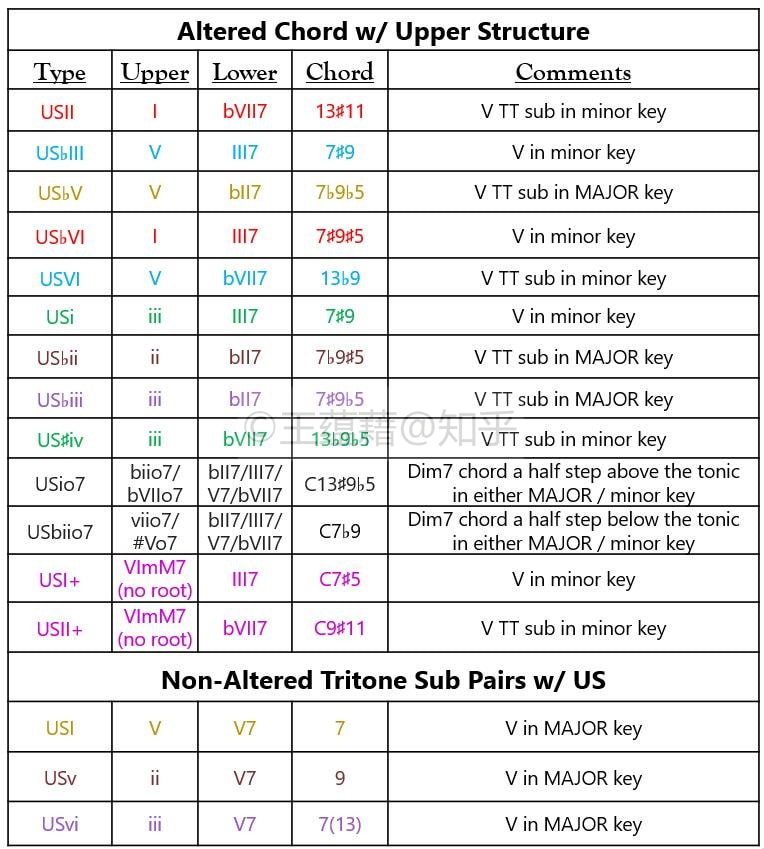
From the above criteria, I came up with the following table:
Picture

4. Analysis

Let's look into what the table suggests. 

First, all the listed upper structures can be fit into a diatonic framework, except for the diminished seventh chords and augmented triads. Nevertheless, it's obvious that the diminished seventh upper structure functions as an approach chord to both major and minor tonic either a half step above or below the target. On the other hand, the augmented triads contain all the notes, expect for the root, found in the tonic seventh chord of harmonic/melodic minor scale, and thus fit well into the V7 chord in minor key.

Second, each altered chord with upper structure has a conjugated chord that shares the same upper structure and a tritone substituted shell chord on the left hand. I've labelled each pair of conjugates in the same color. This means, for example, if we were to play a chord progression from E7#9#5 to Am9, we would get very similar sound by instead playing a Bb13#11 to Am9 progression, because E7#9#5 and Bb13#11 are strict tritone substitution to each other.

Third, and most importantly, if we play the altered chord at the location of the lower structure according to the table, we'll get a pretty decent sounding chord progression. The progression sounds good because the right hand chord for both V7alt and I/i chord will arise from the same key. We can follow the same voice leading principles as when we are connecting simple diatonic triads. For example, an E7#9#5 to Am7 is simply a C major triad going to an Am (or C major or Am7 shell) triad on the right hand.

Moreover, if we connect III7alt to a VImaj7 chord instead of a vi7, we will create a Picardy Third effect in the sound, generating a unique minor-to-major-key-shift effect.
On the contrary, if we connect a V7alt to a i chord, the progression will sounds weak, just like when we connect a unaltered dominant chord to its minor tonic. 

In addition, if we replace the altered chord by its conjugated tritone substitution, we'll hear the similar mystical effect created by tritone substitution. For example, replacing G7(13) to Cmaj7 with G7#9b5 to Cmaj7, will sound very close to replacing G7 to Cmaj7 with G7b9b5 to Cmaj7.

Lastly, conjugated tritone substitution for a major cadential V7 often sounds better as a minor cadential V7, and vice versa. For example, V13#11 resolves to I stronger than III13#11 to vi, and III#9b5 resolves to vi stronger than V#9b5 to I.

​5. Conclusion

Now, I've demonstrated the key information I've discovered from the table. By mapping the upper structure chord into a diatonic context, I was able to compare the altered chords in both lower and upper structures, and group them into conjugated pairs, and study and use them in a more organized way. I hope this article will shed some light on how you may polish the voice leading in your playing of V-I progressions.
0 Comments


Leave a Reply.

    Picture

    王蕴藉@知乎

    吉他乐理老师,《乐理101》、《吉他恋爱手札》专栏作者

    RSS Feed